(Originally published to Glichwave on 8/23/2025)
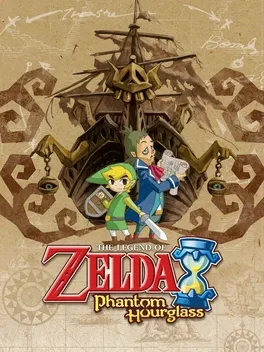
[Image from igdb.com]
The Legend of Zelda: Phantom Hourglass
Developer: Nintendo
Publisher: Nintendo
Genre(s): Action-Adventure
Platforms: DS
Release Date: June 23, 2007
By 2007, Zelda fans had dropped their dismissive attitudes towards The Wind Waker and all of its cell-shaded splendor. Otherwise, Nintendo wouldn’t have dared to consider extending its aesthetic and its distinctive canon in the frazzled Zelda timeline. I wouldn’t consider Phantom Hourglass to be a direct sequel to the GameCube’s divisive entry in the series, but more along the lines of an addendum that continues the presence of this particular realm of Zelda’s world and characters. The blondest and most bulbous iteration of Link is reintroduced to us, sailing on a pirate ship, the closing shot of Wind Waker implying that the events of Phantom Hourglass occur anytime after Link had slain Ganondorf in his watery enclosure. Much to my delight, Tetra is also present on this vessel to taunt Link for his drowsiness like the little scamp she is known to be. One might be excited for Tetra to accompany Link on this new adventure and caustically rib him for a constant source of levity, but we can’t forget that the Zelda series has trouble refraining from using a damsel in distress as its plot catalyst. Much to my chagrin, Tetra and the rest of her pirate crew are swallowed into the cursed grasp of an elusive ghost ship, while Link gets washed up on another beach shore like another certain handheld title from the earlier years of the series. By borrowing a smaller ship owned by a greedy, curmudgeonly sea dog named Linebeck, Link makes like Peter Venkman and embarks on a ghost hunt across the uncharted open waters, with a series of dungeons as progression milestones as par for the Zelda course. “Wait, wasn’t a ghost ship already featured in Wind Waker as a point of minor significance during that triforce quest that made everyone want to slight their wrists?” veteran players might ask. Yes, and reframing this menial aspect of a previous game as the focal point of this entry sets a disappointing precedent that the scope and scale have been substantially trimmed down. Usually, I commend any Zelda title that deviates from the trifecta of Link, Zelda, and Ganon(dorf) and the divine quest that ensues with this classic dynamic at play. In this case, however, the plot premise smacks of inherent handheld inferiority to the console version so much that it hurts.
And the instances when Phantom Hourglass acts as a compromised version of Wind Waker keep rolling along as the game progresses, with more blatant examples rather than the connection I’ve made between the imbalanced framing of its similar plot points. Because this Zelda entry is situated mostly on the surface of large bodies of water instead of the rich soil of Hyrule Field and its surrounding areas, sailing is again a prime traversal component. If navigating through the deep, ocean blue tended to be inconvenient and jarring on a home console, imagine how vexing the process is on a handheld system with lesser performance power. Instead of being at the mercy of the savage sea winds, the sailing in Phantom Hourglass involves drawing the trajectory from the ship’s location to the desired destination with the system’s stylus. Simply draw a line that connects the two, and Bob’s your uncle. While some might think that this method of streamlining the sailing process makes for a smoother trip around the drink, you’d sadly be mistaken. The written route that the player scribbles on their system is stern and immutable, forcing them to halt their momentum completely and redraw another path just for the slightest of deviations. The pen might be mightier than the sword, but it evidently can’t outmatch a baton in directing the course of something. Who would’ve thunk it? In addition to any sort of rerouting becoming a greater ordeal than was ever conceivable in Wind Waker, Phantom Hourglass has a habit of making every sailing trip tiresome by bombarding the player with an influx of hazardous obstacles and enemies. Sure, Wind Waker made certain that the player wouldn’t drift off into dreamland on their admittedly empty maiden voyage on the high seas by including some hostile aquatic foes to add some adversity to the journey, but the number of these confrontational critters never exceeded the number of digits on a single hand per journey. The level of enemy activity in Phantom Hourglass’s waters is technically the same, but five or so enemy encounters in a map whose area is reduced by approximately half of Wind Waker’s expanse, every bit of sailing feels quite tempestuous. Why would there be a constant string of barbed nets popping out from under the surface or aerial attacks from winged beasts and sharks if not to keep the player from dozing off? What exactly is the course of action to avoid Linebeck’s scorned old squeeze, Jolene, from ambushing him with a vengeance when the boat’s base acceleration ranges from motionless to gingerly floating atop the waves? Why don’t I just invite her in for some Dark ‘n’ Stormys while we’re at it? To add insult to injury, the player will have to keep adjusting the camera because it insists on centering in front of Link instead of behind him, creating an unnecessary blind spot that makes him vulnerable to everything the ocean throws at them. It’s fortunate then that there is barely anywhere to explore on this map because Link can only drop anchor on a select few of the more sizable islands that already have plenty of notable sights seen during the main questline. All things considered, I’m actually glad to be beset by these restrictions, for the sense of curiosity that Wind Waker once inspired has been quelled by the tautness of the sailing in Phantom Hourglass. When unlocking fast travel felt as relieving as finding water in the desert for a map where every destination is still a hop, skip, and a jump away from one another, you know the standard means of traversal feels as painful as getting kneed in the groin by a Brazilian soccer player.
Then the prevalence of stylus controls continues to shake the gameplay foundation of Phantom Hourglass until it crumbles into rubble. Anytime I’ve commended or given clemency towards a game featuring an unorthodox control scheme that deviates from the analog stick/D-Pad arrows and symmetrical button assortment standard, they’ve either used the extra novelty sparingly, or were implemented in a game that warranted the unconventional kinetic dimension, such as Guitar Hero or WarioWare: Smooth Moves. For an action-adventure game like Zelda, where the character is constantly moving in a nuanced, multidirectional plane, do you think his controls will be fluid and responsive when the game swaps these fundamentals with something so radically irregular? Let me reiterate what’s at play here and emphasize the full extent of what this means: Phantom Hourglass is the only game I’ve played where all of the console/controller’s buttons are totally relieved of duty, taking a vacation to relax their springs and hinges after being excessively pushed and leaving the touchpad to carry the weight of this title while they decompress. Moving Link involves having him follow where the stylus is being dragged on the screen as if it’s a string with a dollar bill attached to it, attacking enemies with the sword during combat requires either poking or swiping at them with the stylus, and using any of the other tools in Link’s arsenal also requires scratching and stabbing the touchpad like a shitty DJ. The boomerang and bombchu items are the ones that actually thrive with this touchpad schematic because drawing their trajectory is a complementary way to engage their utility. I also enjoy the flexibility of where the hammer item can land with the touch pad, even if it looks comically unrealistic. Integrating the shield in this zone of touch pad controls was evidently so complicated that Link now blocks all oncoming projectiles to his front side automatically. You know the developers are treading on some uncharted territory when they implement a fairy as Link’s partner to ease the player into these innovations, and Ciela even utters the same shrill “HEYS” as Navi once did to “aid” the player through this untested terrain. It’s impressive how every conceivable aspect of Zelda’s typical gameplay structure is translated competently to this almost abstract control scheme. However, it’s ultimately a case of fixing something that wasn’t broken in the first place, so it only generates slight amusement from me instead of awe in between the various annoyances.
Reorienting Link with the touch pad took some getting used to, but I never grew comfortable in dealing with all of the other left-field utilizations that Phantom Hourglass consistently injects into the gameplay. Most DS users probably recall that the touch pad wasn’t the only facet of the handheld’s state-of-the-art mechanical features. We can’t forget that the system had a built-in microphone located in the bottom right corner of the bigger screen, mostly because Phantom Hourglass utilizes it enough to the point where it makes me wonder if the developers realized that people tend to play handheld games in public. The player will be blowing into the mic like home-cooked ziti fresh out of the oven, mostly to either extinguish torches and candles, create manual gusts of wind used to power turbines, etc. I wish the game kept its outside-the-box gameplay to a minimum of exhaling once in a blue moon, but the game seriously expects the player to also screech into the microphone like a chimpanzee. The classic “Poe’s Voice” enemies we’ve seen since the 8-bit days can only be defeated if the player pierces their large rabbit ears with shrill noises. To obtain the salvage arm that hoists up sunken treasure, the craftsman on Cannon Island won’t part with his creation unless the player really bellows for him, a task that triggered a red-faced apprehension as if I was being coerced to sing “Barbie Girl” for my high school talent show. After many casual throat clears that didn’t suffice, he finally parted with the ship part when I screamed, “ALRIGHT SHITBRICK, GIVE ME THE SALVAGE ARM OR ELSE I’M GOING TO RIP YOUR NUTS OFF AND FEED THEM TO THE FUCKING SEAGULLS!!!” Wiped the stupid grin off his face, it did. Incidentally, I am now banned from all public transportation in my major metropolitan area. After the game makes the player liable to be prosecuted for disturbing the peace, the outlying gameplay implementations continue even further into territory I’d call borderline illogical. After finding a chart that reveals the location of an essential item, the player must somehow transcribe this information onto their sea map. Do you want to know how to solve this conundrum? I wouldn’t judge anyone for not knowing the correct course of action, because it defies all rational video game conventions. Should I perform the kind service of informing potential players of the solution to this perplexing puzzle? Nah, because I want everyone to experience the aggravated level of befuddlement so they’ll believe me. I don’t mean for this to sound complimentary, but all of the fourth-wall-breaking quirks that Phantom Hourglass consistently bestows remind me of Kojima’s wild ways that spruced up player engagement in the first Metal Gear Solid. However, the core difference between the two is that the brilliance of Metal Gear Solid’s deck of tricks is their intrinsic novelty in and of themselves, not how the player approaches them. Konami completely realized that the player would likely never figure out the magic behind beating Psycho Mantis, and the sheer ingenuity of such a radical gimmick was never lost on any players. When the developers genuinely expect the player to forgo all proper gaming rationality to progress, it shows a lack of awareness and, honestly, exudes a sense of smug satisfaction from the developers that they’ve “cleverly” stumped the player.
In small doses, the leftfield touchpad puzzles that Phantom Hourglass implements can be effective when they’re integrated as brainteasing obstacles that impede progress in the game’s various dungeons. Phantom Hourglass continues the tradition of dividing the narrative in half between two major collectibles, similar to the Spiritual Stones and Sages in Ocarina of Time. There aren’t any discernible thematic or difficulty differences for the dungeons by this grouping, as their distinctiveness is based on their individual merits. Some formulate their conceptual bases around a well-tested element, as in the case of the Temple of Fire and the subsequent Temple of Wind. The Goron Temple doesn’t necessarily have an elemental component attached, but seasoned Zelda fans can guess that it’s an earthy domain with several two-tonned rocks rolling about, and they’d be correct. The “Temple of Courage’s” unique concept is that every aspect of the dungeon must be approached with the same, consistent directional pattern, which can be jotted down on Link’s map using the stylus as a black-ink marker. On the subject of commonly using the stylus to imprint important reminders, extending this feature to certain puzzles exposes an off-kilteredness in its execution. For example, I know for certain that I traced the invisible path in the “Temple of Courage” perfectly as it was written, but I became confused and infuriated as I kept falling through the alleged cracks of the supposed trajectory. Other than the few instances where the game’s distinct properties pronounce their flaws, using the familiar items to solve puzzles with the touchpad are surprisingly quite intuitive. Hell, regarding the unorthodox controls, rolling a Goron around with the direction of the stylus in his respective dungeon complimented his form of movement far more than Link walking about on his little legs. In addition, boss battles that utilize the kinetic extensions of the items are incredibly engaging, such as creating a rope barrier with the hookshot to bounce fire and ice balls at the twin Gleeok heads and using the detached nature of the hammer to smash chunks of the giant stone titan, Eox.
However, no amount of nifty touchpad tricks can salvage the dungeon in Phantom Hourglass that keeps rearing its ugly, multistoried head. The Temple of the Ocean King isn’t a dungeon in Phantom Hourglass; it is THE dungeon of Phantom Hourglass, the sun that all of the lesser planet dungeons revolve around in the Phantom Hourglass galaxy. In this context, I kept praying that this flaming astral body would die in a majestic supernova, but it unfortunately persisted like a case of herpes. Like the aforementioned STD, The Temple of the Ocean King is a chronic occurrence, revisiting Mercay Island and hiking to its northern tip after completing a dungeon and obtaining its core collectible. The direct descent down the temple’s catacombs gets deeper upon every visitation, unlocking a handful of new floors that lead further into the secrets the ancient architectural structure holds. The catch is that no matter how extensive the temple becomes as the game progresses, the player is forced to start from its entrance and work their way down to the lowest point every single time. Imagine if the same thorough process were mandated for Tartarus from Persona 3: the game would simply become unplayable at that point. Sure, the game offers a teleportation portal that transports the player to the temple’s halfway point, but the unfortunate caveat behind this supposed act of clemency is that they’ll have to trek onward with the time they arrived at this point on a previous run. Yes, perhaps the ultimate difficulty stipulation surrounding this massive temple is that there is a clock ticking, or an hourglass draining in this instance, throughout the player’s journey further down the depths of this dank, ruptured pit. It goes without saying, but if Link fails to find footing at the lowest position that this dungeon allows, he’ll succumb to whatever old noxious fumes are stewing down here (asbestos?), and the player will have to revert back to square one at the entrance. Add to this tense condition the fact that the beefy, impervious Darknuts that vigilantly roam every corridor will subtract one minute off the clock if they successfully snatch up Link, and finding the solution to unlock every floor here is a stressful, aneurysm-inducing escapade. Admittedly, there are plenty of translucent pools that act as safe zones where the timer stops, and Link is imperceptible to the Darknut guards, plus sand can be found in some sunken treasure chests to increase the maximum time allowed. In addition, gathering more of Link’s staple items as the game progresses can considerably mitigate the time spent on a single floor. Still, while the leniency is appreciated, I’d rather put a formal stamp on my progress and continue into a batch of new floors every time I am forced to excavate this godforsaken place. Retreading each floor here is a mind-numbing process that grated on me as no previous dungeon has ever before, reminiscent of having to return to the slowest white-collar job imaginable five days out of the week to continue enduring the boredom and tedium of it all for what seems like forever.
Tis a shame then that there is actually an admirable veneer of genuine substance underneath all of the vexing newfangled innovation that Phantom Hourglass insists upon. I’ve often expressed that there is a subcategory of “alternative Zelda games” that deviate from the standard series arc of a prodigal hero conquering the essence of evil with a princess as a crucial key in the villain’s sinister goals. The plot premise of Phantom Hourglass might give off a bad impression that the game’s alternative means of sprucing up the series is but a paltry appetizer to the full-course meal of the Triforce arc, but the narrative stakes expand extensively once Link visits the Ghost Ship that abducted Tetra at the game’s midway point. The antagonist of Phantom Hourglass is not a rogue spirit ship, but a nasty, enigmatic entity named Bellum who thrives on draining the life force from its victims, hence why Tetra has been reduced to a petrified stump. Bellum isn’t exactly a strong villain in the narrative sense, but the heightened stakes he provides allow for a genuine growth arc involving the game’s primary partner character. Those who are grief-stricken by Tetra’s absence will be glad to know that Lineback is a suitable surrogate whose sardonic banter with Link is sure to lighten up the experience in somewhat of an equal measure. Still, Linebeck proves to be far more than the player’s source of entertainment with his constant jackassery, as this salty sea dog’s lust for hidden treasure shifts to authentically strive for heroism once he sees how Link serves as an example. It’s quite touching, believe it or not. Still, Linebeck is not the game’s only source of levity, as the game finds ample time to flex its lighthearted chops in several instances, like when old man Oshus snatches an hourglass from Link with impeccable, unexpected comedic timing or when the player can send whatever message to Jolene in a handwritten note when challenging her to a final duel. I promise it wasn’t vulgar (fingers crossed). Even Ceila and the other fairies that Link recovers have enough conversational dialogue with other characters to elevate them above the nagging, buzzing tutorial device that everyone associates them with because of Navi. Not an easy task, believe me.
How interesting it is that Nintendo decided to showcase a tech demo for the DS after the handheld system had been released for almost three years prior to the release of Phantom Hourglass. One might argue that the overall experience is too lofty to fit into the connotations of a meager test sampler, but if it looks like an apple and tastes like an apple, I’m obviously not going to call it an orange. Actually, now that I think about it, Phantom Hourglass's fully-fledged Zelda content, befitting of a bona fide series title with all of its quirks at play, suggests something beyond showing the capabilities of the system, but rather, illustrating the evolution of gaming that exists beyond the cut-and-dry control scheme of button pushing. Nintendo may beam with pride that they’ve accomplished this just by the fact that Phantom Hourglass is relatively functional, but that’s only true on a purely fundamental basis. Given the tremendously awkward and stilted manner of movement in many instances, especially regarding the sailing, which I didn’t think could get any more rigid than in Wind Waker. Still, the game incorporates plenty of other non-touchpad-oriented properties that would be as egregious with a traditional control scheme. I despise the Temple of the Ocean King so much that mere mention of it is like uttering an inflammatory slur in my direction. If Phantom Hourglass weren’t a slave to its motion control conceit, then the peppy, dynamic character writing and utilization of Link’s items would’ve placed it amongst good company with the more liberal, unconventional Zelda titles.


No comments:
Post a Comment