(Originally published to Glitchwave on 8/18/2025)
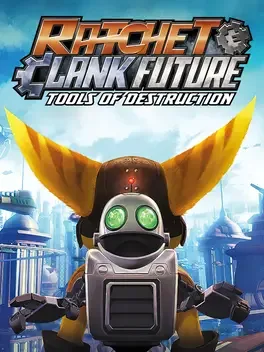
[Image from igdb.com]
Ratchet & Clank Future: Tools of Destruction
Developer: Insomniac
Publisher: SCEI
Genre(s): 3D Platformer, Third-Person Shooter
Platforms: PS3
Release Date: October 23, 2007
Let me just gush over the game’s presentational qualities for a second. Even though I had seen plenty of screenshots and gameplay footage of Tools of Destruction since its release, I never truly felt the extent of the game’s glossy, nouveau sheen until I experienced it in an intimate range. The series of Ratchet & Clank games on the PS3 all included the subtitle “future” to possibly wedge some conceptual discernibility between them and the PS2 titles, but it could easily also apply to the leap into a high-definition display of video game graphics. What better way to flaunt the crystal-clear fidelity of the next generation by buffing the series staple setting of the Kerwan metropolis? After our duo crashes their futuristic vehicle after conducting some unsuccessful tests on it, their journey through their current address that we’ve seen plenty of times before now shines as radiantly as the light beaming through a stained-glass church window. Kerwan’s “Metropolis” has always exuded an aura of busyness, especially since it's a city of the distant future where the overall activity around the area is expected to exceed any city congestion we can possibly fathom. The PS2 games did a fair job at least conveying the intended atmosphere of such a setting, but the perk of high-definition really homes in on the magnificence of the urban sprawl. The level of detail in both the foregrounds and backgrounds is impeccable, with dozens upon dozens of towering buildings looking as if they were constructed with reinforced steel only found in the esoteric reaches of this far-off galaxy. Air traffic looks to be dizzyingly hectic, and I swear that I can see Ratchet’s reflection in that golden Qwark statue found in one of the setting’s many plaza squares. This prologue tutorial section also sees the return of grind rails after Up Your Arsenal omitted them as part of its action-intensive initiative. While every fan should be gleeful that this precarious form of automated platforming is making its triumphant return, let's be honest, it’s integrated here to give the player a grand tour of the graphical spectacle of the urban environment surrounding it. Fritz Lang would’ve shed a single tear if he had lived long enough to witness this showcasing of a futuristic society that he provided the template for so long ago. I realize that this game is almost two decades old at this point and may not uphold the graphical quality that is achievable in present-day gaming, but as an avid Ratchet & Clank fan who has only seen the series through the slightly fuzzy display of standard definition, it’s an awe-striking treat through and through.
Perhaps the introductory segment in Kerwan sets a misleading precedent for the remaining duration of the game, implying that all of the following areas are HD retreads of familiar planets from the Solana Galaxy. However, Ratchet and Clank’s first HD adventure orbits around the Polaris Galaxy, which is being subjugated by a pint-sized, staff-wielding tyrant named Emperor Percival Tachyon, whose prejudice against Ratchet stems from the Lombaxes wiping out his species in a great war that occurred eons ago. Need I remind everyone that this antagonist was created by the same developer who brought Ripto into existence? I’ve heard of a Napoleon complex, but a Napoleon fetish? Anyways, the series of celestial bodies under the diminutive dictator’s control is rendered equally exquisitely as the familiar stomping grounds of the franchise. On Planet Cobalia, which follows the Kerwan prologue, the immediate trajectory will eventually lead Ratchet to a more industrial settlement in the midst of a humid wasteland with savage alien creatures. It’s similar to finding the abandoned Megacorp Outlet on Planet Oozla in Going Commando, but there’s a certain cinematic framing while in the manmade section of Cobalia that evokes the same impressive flow of activity present across Kerwan. The lava surrounding Planet Rykan IV illuminates the station at its center beautifully, and Planet Fastoon effectively illustrates the fallout of the former Lombax civilization. Space piloting segments also return after Up Your Arsenal deemed them unfit to coexist with shooting, and the pulsars and starry superclusters that comprise the visual backdrop are akin to the most extravagant light show imaginable. Space is the place, indeed.
It’s a given at this point that Tools of Destruction looks good enough to eat, but does it fix the issue of linearity that Up Your Arsenal was rife with in the name of pronouncing high-octane shooting action? Marginally, I guess. The number of planets that feature branching paths as the series used to provide is available, but are ultimately sparse in their appearances. The robotic space pirate hub of Planet Ardolis has a grind rail to the left side of the entrance, and following this detached road to its end will result in Ratchet acquiring the component of his armor that magnetizes bolts to it. This planet also obliges the player to revisit it once they obtain the pirate disguise, and unlocking the pathways with said outfit will lead the player towards some golden bolts for their troubles. Other than the instances on Ardolis, other ways in which Tools of Destruction fractures the A to B linearity of shooting hostile shite to bits can be argued if they qualify as such. Mostly, it’s the occurrences of searching for formidable alien leviathans to then trade their souls to a grizzled smuggler, harkening back to killing races of mammoth monsters to collect crystals in Going Commando. The Jurassic jungles of Planet Sargasso provide the traditional wide open plains similar to the settings that fostered this kind of exploration in the series’ second PS2 title, but I think I prefer warping between portals on the remote Nundac Asteroid Ring just for the novelty of this transportation method alone. Ratchet’s new gruff-speaking, toothpick-chewing friend’s black market connections make him the only one fit to sell this game’s iteration of everyone’s favorite juggernaut missile launcher in the universe: the RYNO IV. However, instead of having Ratchet pay an exorbitant amount of bolts for it or give it to him as a reward for completing the game and starting NG+, Ratchet needs to find the scattered schematics for the smuggler to build the weapon in the first place. Finding the blueprints for the series' most famous acronym takes a considerable amount of scrounging around off the beaten path, and the constant process of meticulously looking around every nook and cranny between every wooden box constitutes enough non-linear exploration to satisfy me, with all things considered.
Because the RYNO is in pieces for the vast majority of the game’s run time, the player will have to settle for the inferior array of weaponry purchased from the electronic vendors located with every checkpoint. Still, the eclecticism of Ratchet’s arsenal is arguably the series’ most notable idiosyncrasy, so the new slew of futuristic weapons to use will be an exciting prospect as always. Unfortunately, much of the selection in store here indicates that the weapons have bunked themselves into tropes based on their functional similarities to those from the previous games. “The Combuster” is your run-of-the-mill blaster that aids the player through the less complicated terrain of the early game, the “Buzz Blades” are the same bouncing barrage of sharp circular objects we’ve seen before, and the burst of needles that erupts after every shot of the “Shard Reaper” can’t fool me from the fact that it’s a glorified shotgun. The “Shock Ravager” isn’t inherently derivative as an energized, alternate melee weapon, but it’s of the same whip variant as the “Plasma Whip” from Up Your Arsenal. Still, considering the haphazard “Razor Claws” that make the player liable to take damage instead of dishing it out, perhaps attaching the weapon to a handle is the only way of making a melee weapon practical. Even the “Fusion Grenade” has the same icon as every other explosive weapon, which eases the player into the combat during the introductory stages of the game. Other than what seems like series requisites at this point, Tools of Destruction does display some genuine strokes of genius in the department of eradicating enemies. The ameboids that once squawked at Ratchet while trying to chomp him can now be used at his disposal with the “Plasma Beast,” planting the sentient boogers near enemies to then pop out and pulverize them with their gelatinous fury. Weaponizing a few of the Egyptian plagues takes place with the deadly bugs of the “Nano-Swarmers” and the “Tornado Launcher,” which localizes the blustery weather phenomena to wreak havoc in a smaller radius for a brief period. If all of this firepower isn’t enough, the “Alpha Disruptor” is a worthy substitute for the RYNO that will shred through enemy defenses once it's charged. Honestly, who needs the RYNO when this massively catastrophic cannon does the trick, and for no fees upon its discovery at that? To sweeten the deal, any weapon can be upgraded outside the standard level progression by applying enhancements to it via the allotment of raritanium, a recurring secondary currency that is implemented wonderfully here. Still, it makes me question why the level upgrade system is still in place, as designating which attributes to enhance in this more methodical fashion feels far more player choice-oriented and therefore more engaging.
To feasibly fit all of these deadly new doohickies into Ratchet’s pockets, Tools of Destruction implements THREE circular rings so the player can select one of these weapons at their convenience. One more ring than what I’m accustomed to sounds spacious enough, but an entire wheel may become entirely dedicated to a new idea that Insomniac conjured up. In the proximity of a weapons unit, another vendor will sell Ratchet “devices.” These auxiliary doodads are intended to supplement the primary weapons during the more hectic moments of combat. For example, the “Leech Bomb” will parasitically drain the lifeblood of enemies, giving the player a surplus of health in a pinch if needed. Similarly, Ratchet can also toss a disco ball called the “Groovitron” out on the field to distract every enemy in close range with the infectious lights and rhythms of the penultimate fad from the 1970s, dancing nonchalantly and leaving themselves vulnerable for Ratchet to decimate. While I enjoy the devices based on their utility, I have to wonder why each of them was consigned to a strict supporting role. Because the devices have to be used sparingly and cannot be upgraded through leveling or through Raritanium channeling, the player is barely given any incentive to use them. That, and I’m offended that the classic Morph-O-Ray had been done dirty with its demotion to a device here, turning enemies into robotic penguins with one fling like a flash grenade. If the developers saw how masterfully I transmogrified countless Protopets and thyranoids into cuddly farm animals over the course of the PS2 trilogy, they might have reconsidered relegating the weapon to something the player uses in a pinch. For the game’s sake, it’s fortunate enough that Tools of Destruction puts the player in plenty of drastic situations where the devices are useful, with many of its boss fights. I had to exhaust every Leech Bomb in my inventory because the Kerchu Mech kept smashing Ratchet below the arena’s rafters, and distracting the swabbies of pirate crew captain, Romulus Slag, with the iridescent disco ball was mandatory because his homing energy hooks were already enough to evade all at once. Still, when have the weapons in Ratchet & Clank ever been entirely situational? What reason do the developers have for not integrating these devices into the mix with the prime time weapons? They all take up a precious slot in Ratchet’s inventory wheel regardless!
Besides, Ratchet & Clank have always had non-offensive contraptions used circumstantially with the gadgets, which continue here as another facet of the series’ gameplay. Joining the series staple Swingshot are the Heli-Pods and Gelanator, which manually lift platforms that have an indicator on them and bounce Ratchet upward like a trampoline on a blocky piece of green Jell-O, respectively. I quite enjoy the general utility of the latter gadget mentioned, but I wish that the instances of using the gadget weren’t allocated to such super-specific sections where its utilization is made obvious. Other than the ones that were mentioned and some other requisite items like the Charge Boots and the Hydro-Pack, the remaining gadgets featured in Tools of Destruction can be grouped together by a certain gameplay gimmick that was not feasible in the original trilogy. Lest we forget that during the development of Tools of Destruction, Nintendo was reeling in so much money with the Nintendo Wii that it was borderline criminal. Unwilling to take their market domination sitting down while also not acting bold enough to alienate their avid gamer demographic by completely copying Nintendo’s homework, Sony still implemented minor motion control functionality with the PS3’s iteration of the Dualshock controller. Insomniac figured that the gadgets were used infrequently enough and therefore found a way to comfortably administer gaming’s then-latest kinetic trend sparingly enough without compromising on the meat of the gameplay. Still, despite how light their prevalence is in the overall experience, every instance of motion controls leaves a bad enough impression on the player to negatively resonate with them. The Robo-Wings were incredibly sensitive to any mid-air directional alteration, and if the segments using the Geo-Laser were used as a police sobriety test, they’d haul my ass to jail because every earthy extraction I formed with it was messy enough to make it look like I was shit faced. The developers thankfully give the option to use the analog stick while continuing an electrical current with a metallic ball in this game’s hacking minigame, but I discovered this instance of clemency only after I quit one of them in frustration. Dodging incoming missiles while falling into the battlefield from the skies, as Ratchet occasionally does, is also now dependent on how the player swerves the controller like a steering wheel. However, in this instance, the player also needs to use the analog stick like normal to direct Ratchet’s movement, so what the fuck was the point in applying motion controls to this segment at all? Let’s hope that the developers found as much fault with these little trendy tweaks to the gameplay formula as I did, but I have a feeling that they’ll persist with every PS3 entry in the series that follows and won’t be improved upon.
While Ratchet’s gameplay is being bogged down by an attempt to capitalize on the success of the console competition, I’m glad to report that the few moments where Clank is front and center have barely been changed. He doesn’t enlarge himself to the bodily proportions of a city-destroying Transformer in this game, but any section where he is roaming around at his standard, miniature size is quite loyal to how they were executed on the PS2. Ratchet’s backpack buddy will journey through tighter territory while being accompanied by a posse of even tinier robots who will attack enemies on Clank’s command. This time around, however, Clank’s little army holds relevance to the game’s narrative, surprisingly enough. Their small statures notwithstanding, the “Zoni” are a powerful race of interdimensional robotic creatures who can bend and manipulate the space-time continuum at will. Given that they’ve granted usage of their extraordinary ability to Clank and that they only make their presence known to him and him alone, they certainly recognize the tiny tin man as a worthy warrior fighting for the benefit of the galaxy.
Truthfully, this segway I’ve constructed was not rooted in how the developers wisely chose not to fix what wasn’t broken regarding Clank’s gameplay, but to extend my gripes on how Tools of Destruction continued to adulterate the elements of the franchise. Namely, in this case, how our heroes are now being propped up in the narrative as deific figures that are foretold to bring peace and balance to the cosmos, as told in an ancient prophecy. Clank’s awareness of the Zoni is just one factor of this narrative scope, but Ratchet’s role has been equally blown out of proportion. Other than taking umbrage with the fact that his species condemned his people to extinction, the reason why Tachyon is targeting Ratchet so fervently is because Ratchet is the last Lombax that remains living and breathing, and Ratchet’s role as the sole survivor is elevated even more when he says, on record, that he’s never known another being of his kind in his life. Need I remind Ratchet that crossing paths with Angela was a major narrative factor of his past adventures, and that he assumedly fornicated with said female lombax after the Protopet menace was conquered? Other than the developers’ glaring attempt to retcon a firmly established character in the series’ universe, do you realize what Ratchet has been positioned as with all of the context we’ve been given? That’s right, furry orange Jesus; the extolled, solitary savior of the space age. Considering the privilege of interacting with the Zoni, Clank has also been put on a pedestal as a metallic, mechanical Jesus. Believe me, I saw the birth of this robotic runt, and it was anything but divine. Still, I don’t mean to undermine my favorite character from this franchise because his and Ratchet’s modest pluckiness is what made them great protagonists. A recurring theme of the original trilogy is that despite saving the galaxy on three separate occasions, the duo never truly received their due credit as those to be commended and celebrated for their feats. The series consistently gave more veneration to superficial “heroes” like Captain Qwark through its lens of social commentary, furthering this thesis by deferring Clank to a household name status until he starred in the lead role of a television series as a fictional hero. Their heroism always spoke for itself, and when it's hoisted to the heights of biblical destiny, their charm as passionate do-gooders is completely ousted. Even Talwyn Apogee, Ratchet’s new female ally, starts overtly flirting with the lombax immediately upon meeting him. Ratchet is supposed to earn your arousal, dammit!
While Ratchet & Clank Future: Tools of Destruction feels like the triumphant leap into a newer and bolder future for the franchise, especially from my perspective, I can plainly see that it’s a product from the past era of gaming, from when it was released. The high-definition visuals are breathtaking, even for those who are not accustomed to seeing the space cat and toaster combo with CRTV haziness, but they are not enough to distract from all the eye-rolling practices it commits to that were common during this time. Not even my beloved Ratchet & Clank was immune to dabbling in poorly executed motion controls, and ennobling the once-cartoony satirical series to the overblown realm of a space epic like Star Wars leaves a bad taste in my mouth. Ratchet & Clank was the one series whose original developers did not defect and sell off, but the ways in which Tools of Destruction profoundly misunderstands the strengths of the franchise make it seem like it was created by a new team from another company. Still, I enjoyed all of the elements that were maintained from the PS2 games that were extended efficiently here, so the “future” doesn’t seem entirely dim and grim. However, a future that makes me yearn for the past isn’t exactly radiant either.


No comments:
Post a Comment