(Originally published to Glitchwave on 8/27/2025)
[Image from igdb.com]
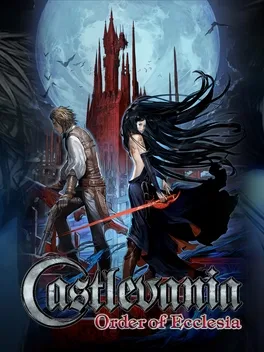
Castlevania: Order of Ecclesia
Developer: Konami
Publisher: Konami
Genre(s): Metroidvania
Platforms: DS
Release Date: October 21, 2008
Certainly, the “noun of noun” title sequence of this game should raise some eyebrows, considering that “ecclesia” is an obscure term not often uttered in modern society outside of ultra-specific academic circles. Order of Ecclesia is not using “ecclesia” to reference the gathering of people in an ancient city-state as per the traditional definition, but it does pertain to a fictional coalition of people forming with the common goal of destroying Dracula. In this era of the wonky Castlevania timeline, the lineage of Belmonts that have dutifully served as the anti-Dracula task force for centuries has evidently gone missing or has given up. Either or, this consortium of people has taken the mantle of oppressing Dracula’s ascendancy to ensure peace and prosperity for humankind. One particular person in this organization, our protagonist Shanoa, is chosen by her peers to wield Dracula’s power, which has been concentrated into three glyphs referred to as the “Dominus.” Alas, as the aphorism that “power corrupts” dictates, Shanoa’s colleague and dear friend, Albus, swipes the three Dominus glyphs during a vital imbuing ritual for Shanoa. Because Albus cannot be trusted with such a volatile essence of pure dark energy, Shanoa must make haste to her blood brother before he does anything rash with the precious glyphs and causes cataclysmic damage to either himself or the world at large–all while recovering from the amnesia that the ordeal inflicted on her. Overall, the focal point of this plot premise that people seem to commend is the fact that a female protagonist is finally at the forefront of a Dracula destruction mission, or at least one that isn’t as mechanically suppressed as original Game Boy title Castlevania Legends or one where the heroine isn’t sharing the spotlight with the typical masculine narrative vehicle like in Portrait of Ruin. But who is to say that Charlotte wasn’t the one driving the Johnathan tank to blow open the towering ivory doors of Dracula’s chambers? Semantics aside, it’s still marvelous that this pretty young witch with the long, black, silky hair has been propped up among the generations of Belmonts as the main crusader against The Count, and it has very little to do with her smoother skin and higher estrogen levels. On a system whose Castlevania output has been using the conceptual foundation of a previous entry to craft a sequel and a spiritual successor, respectively, receiving a title that totally abandons any hint of narrative familiarity and plops itself onto an uncharted area of the Castlevania chronology is as fresh as a spring breeze. Perhaps erecting a new narrative completely removed from any Belmont relevance is the only way in which a woman could trespass into Dracula’s domain, which begs the question of whether the vampire-killing family only produces male offspring.
If you thought that Order of Ecclesia breaking the series’ stained-glass ceiling and granting a woman the job of conquering Dracula or one of his disciples was outrageous, get a load of how the game approaches the series’ Metroidvania utility-gated progression. There isn’t a solidified rule in the Metroidvania design book dictating that the setting should be a monolithic, barricaded construction or a series of distinctive areas with branching pathways that connect to establish a cohesive fluidity between them. The reason why Dracula’s Castle worked wonders in demonstrating a template for every subsequent Metroidvania game in the genre’s relative infancy is because the majority of the areas in the pre-Metroidvania titles existed within the confines of Dracula’s distinguished domicile, which subtly illustrated that there was already a sense of interconnectivity that was just being segmented as par for the linear, traditional 2D platformer course. Portrait of Ruin played with the idea of fracturing the narrative's harmony through the castle’s various corridors with the painting portals, teleporting players to areas that were totally detached from the central castle with unique geographical and aesthetic distinctions in their isolated parameters. Still, the player would continually revert to the castle motherland once they reached the dead end of a boss room, so the maverick potential of this idea was ultimately squandered. Well, Order of Ecclesia boldly continues what Portrait of Ruin hinted at by cutting out the castle middleman entirely, offering up a slew of completely uncoupled levels on a world map screen that are presented as matter-of-factly as picking a planet in a Ratchet & Clank game. Some Metroidvania purists might get huffy at the developer’s unflinching decision to divide Order of Ecclesia’s world in this manner, and they’ll likely furiously debate whether or not the game can classify itself as another entry in this elaborate category of 2D platformer when it hardly upholds this crucial design element of the genre. I’m siding with the more optimistic opinions regarding Order of Ecclesia’s design direction, for I’ll argue that the utility-gated, revisitation aspect is equally as integral to the Metroidvania definition as the sprawling, interconnected world where locking the entryways takes place. Admittedly, however, instances of this rarely occur throughout Shanoa’s adventure. Shanoa can explore the sea floor of the stormy Kaldius Channel once she tacks on density, and she won’t be able to warp through a select few walls scattered about the land until she is almost face-to-face with Dracula. Other than these few instances, progressing through each locale is a fairly straightforward trek from the entrance to the boss with a few deviations sprinkled about. Flattening the course of these Castlevania areas may spurn the Metroidvania enthusiast crowd that Konami has been appealing to since Symphony of the Night skyrocketed off, but I believe that the linear level design on display here will generate a sense of intrigue from the deferred fans of “classic Castlevania,” provided the RPG gameplay components aren’t too incongruous to ruin their nostalgia trip. As someone who is a fan of both sides of the 2D Castlevania coin, I’ve been jonesing to experience environments that the series used to showcase outside of the manmade architectural confines of a castle interior–and including more organic, outdoor areas such as caves, forests, reefs, swamps, etc, satiates my cravings. Come to think of it, the series hasn’t allowed the player to explore environments like these with such liberal progression parameters since Simon’s Quest. Holy shit, has castle fatigue really seeped in that deeply that I’m pining for the forgone practices of THAT game?
Continuing the ways in which Order of Ecclesia gives Simon’s Quest more credibility than it probably deserves, selecting a particular area icon depicted on the game’s world map will lead Shanoa to a level that is considerably less hectic than the others. The Wygol Village is discovered once Shanoa glances at a map that Albus carelessly leaves behind during an encounter with him at a monastery. She journeys towards where X marks the spot on Albus’s little reference page to find a quaint little burg that greatly evokes the rustic nature of a remote European settlement from the century in which Order of Ecclesia is set. Still, Shanoa finds this unadorned village to be so tranquil that it verges on suspicion, and those uneasy feelings are affirmed when she learns that all of its inhabitants have been afflicted with a catatonic curse caused by Albus. Wizened Wygol elder statesman, Father Nikolai, is the only citizen of this burg to be left in stasis here, while all of the other residents of this rural civilization were unfortunately ensnared by Albus while out and about. Freeing the remaining townsfolk from their cursed captivity becomes the game’s overarching secondary task, like a collectible. Some can be found paralyzed along the intended trajectory, while others require a slight digression to rescue on account of being frozen off the beaten path. A couple of these poor saps have even managed to get themselves stuck behind inconspicuous crevices where I’m not sure if Shanoa could hear their cries for help, even if their vocal cords weren’t rendered kaput. The callous, less conscientious Castlevania fans might ask why Shanoa should care if Albus immobilizes a dozen rubes, but other than receiving the ethical satisfaction of aiding those in need, Wygol’s denizens will show their gratitude towards Shanoa’s efforts by offering their wares once they hurry back home. In any functioning community, there are services established to ideally keep its economy flowing everlastingly like the Amazon River. Shanoa can potentially save all of society’s staple vocational VIPs to, in turn, receive more effective healing items from thief-turned-healer Abram, nutritious home cooking from the fatherly and motherly Aeon and Irina, rare jewels from the beautiful, buxom Laura, etc. Taking photographs of specific creatures for Marcel will earn Shanoa an ample surplus of cash for her troubles, which will likely finance the prices for their commodities that are sold by shopkeeper Jacob. A more meticulous foraging throughout each level for these nice, honest folk is not inherently the issue regarding this overarching side quest, for any piece of uninvestigated land I can detect on the map in a Metroidvania game will be trekked towards out of natural curiosity, regardless of whether or not I suspect that something notable is located there. Rather, I can smell a ruse behind this ongoing sidequest, unveiling some nonoptional conditions behind this perceivably optional exploit, considering that so many Castlevania essentials like a shop and its products are locked behind these stipulations. I’m not enthralled with all of the busywork the game has assigned to earn what should be readily available to the player, or at least be unlocked all at once at some point.
As much as I wanted to testily tell George the musician to find his own fucking eagle feather or inform Abrahm that he can take his precious mandragora root and shove it up his ass, my recalcitrance would’ve conflicted with my desire to continue making progress in this game. My status in the game’s narrative was at the mercy of the villagers’ various requests because Order of Ecclesia is harder than a porcelain toilet situated outside for days in a freezing tundra. Not since Circle of the Moon has a Castlevania game bombarded the player with a consistently blistering challenge curve, and one could argue that it’s another instance of Order of Ecclesia paying tribute to the classic Castlevania titles. In fact, the severity of the environments is the main factor that makes these linear levels substantive, as was often the case for the earliest ones in the series. Single-screen spaces are congested with an army of enemies, all bringing their best efforts to slaughter Shanoa like a pig. I especially became overwhelmed by the rate of enemy onslaught on “Minera Prison Island” because I kept inadvertently summoning the disturbing-looking “Evil Force” devil heads and the melee-impervious “Tin Men” that butchered me in seconds as a penalty for stepping into the rotating spotlights while trying to fight the winged demons overhead. The space between a safe room and its nearest boss are again a relevant discussion topic as they were in Circle of the Moon, for Order of Ecclesia has distanced its manual checkpoints further away from the spacious boss arena at what I’d call a “festival bathroom” distance when every game after Nathan Graves’ adventure kindly placed them right outside the mighty milestone foe for their convenience. That is, until the adversity between the two destinations becomes so ruthless and distressing that the developers start placing them as neighbors once again anyway. Above all other demanding elements in Order of Ecclesia’s spicy difficulty brew is the fact that Shanoa has little to no defensive constitution to speak of, as every bit of damage received from any enemy shredded her life bar down to its slightest sliver, like she’s being crammed through a wood chipper. Are we one-hundred percent certain that she isn’t the daughterly descendent of Richter Belmont? They both share that clear distinction of lacking an invincibility frame, which pisses me off as royally here as it did in Rondo of Blood. Combine this handicap with the costly price of healing items, along with their insufficiencies, and every outing outside of Wygol Village is like walking on hot coals. Needless to say, the harshness surrounding the trek towards a boss is equally applicable once inside the intended destination. Scaling the lighthouse while that gigantic crab stabs at Shanoa with its massive claws was particularly hair-raising due to the vertical construction hardly having any solid footing to support oneself on, and I’m fairly certain that she can’t prevent herself from getting trampled by the boss in “Giant’s Dwelling” when he stomps from one side of the screen to the other. I’m no stranger to a Castlevania game that makes the player suffer, nor do I inherently dislike the titles that tend to do this. However, in this case, it’s another instance of the game suspiciously stripping away at the accessible evolution the series had reached so long ago at this point.
In my struggle to survive Order of Ecclesia, I had seemingly forgotten the golden, mathematical rule in Castlevania that “woman=magic user/sorceress.” The game’s rigorousness compelled me to cast more spells than I probably did throughout my entire time playing as Charlotte in Portrait of Ruin, and a certain system that Order of Ecclesia implements makes summoning magic second nature. Castlevania combat in Order of Ecclesia is arranged via “glyphs,” which are obtained on the field when Shanoa absorbs them through her mythical tramp stamp back tattoo. These arcane curiosities enable all measures of Shanoa’s abilities, including the usage of melee weapons, magic, and circumstantial traversal perks. They’re mostly found radiating off of specific statues, but they can also be sucked from enemies either upon their defeat or whenever they start attempting to attack Shanoa with their respective magic blasts. I know what question is about to escape your lips, and it’s “isn’t this a more complicated reworking of the shard system from the two Sorrow titles?” Believe me, I came to the same conjecture, but the glyphs manage to prove themselves as something more than another instance of Order of Ecclesia taking something familiar and smooth from a previous game and making it a pain in the ass, as it is often guilty of doing. Because all combat is coordinated through one system, each of the components is intended to be used in equal measure. Swiping at enemies with swords, axes, and rapiers will chew through a bit of the green mana meter below Shanoa’s health bar just as conjuring up fireballs and ice clusters as it normally would, which I began to interpret as Shanoa’s stamina to prevent myself from pessimistically griping that performing any amount of offense comes with a cost. Also, because both forms of offense are intertwined here, they can be fused as a “union glyph,” a super-effective attack that combines the elemental properties of the equipped magic with the equipped weapon whose usage coincides with the heart counter. Due to the frantic atmosphere that each area upholds with its torrent of enemy activity, I ended up using the union glyphs more than the halves they consist of, consuming more hearts than the Aztecs in the process. I appreciate that the developers have discovered a method of placing both melee and magic in proportionate standing, but the way that it is organized is far too irregular to foster the streamlining that the developers likely had in mind.
Considering that the main progression pathway in Order of Ecclesia is brimming with chaotic danger around every corner, it’s enough for the player to gloss over the villagers and pray that their suspension spell will just wear off like being turned into a newt. However, in addition to their essential, albeit expensive, services, saving every last one of Wygol’s citizens is the primary condition that Shanoa needs to fulfill to unlock the second half of the game and the “true ending” by proxy. After finally fighting Albus and defeating him, Shanoa will spend the remainder of her quest in the gothic enclosure of a certain vampiric lord’s manor. Before you make any outstanding assumptions that the game has compromised on its integrity with its return to familiar territory, I must inform you that the trip through Dracula’s Castle in Order of Ecclesia’s climax is conducted much differently than in previous iterations. Firstly, because the entirety of the castle is designated to the latter portion of the game, progression snags are seldom an issue in traversal. The straightforward level design seen across each area prior greatly complements the pacing for a true ending route, and the wonderful aspect of it is that the length is the truncated part here, not the expanse. Dracula’s Castle retains all of its notable set pieces, usually found when it's the pillar of a Castlevania title with the same architectural breadth. Medusa heads still fly in their synchronized flight pattern in the vertical clock towers, the library is still swamped with stacks of books, and the bridge at the castle’s peak leading to Dracula’s chamber is still collapsed. Still, revisiting the most essential estate in the gaming medium bears a bigger mission than to capitalize on a last-minute journey down memory lane. Three keys representing the trio of Cerberus heads are needed to unlock the passageway into the core of the castle, and the keepers of these keys are easily three of the most punishing protectors of Dracula’s quarters. The cybernetic centaur, Eligor, requires several steps that must be proceeded with utmost caution, and Death is prone to shredding Shanoa’s health bar down to nothing in seconds thanks to his storm of scythes and swift slashing. Above them all, the one that earns the crown for the king of pain and suffering is Blackmore and his shadow demon persona he casts over the walls. The meteors he spews have an avoidable pattern that is learnable, but whether or not Shanoa will survive his fight when he stretches his arms back and forth is up to the divine decisions of RNGesus. Still, the hidden beauty in all of these duels is that the player can pick their poison and approach any of them in the order they see fit. Walking through the ornate halls of the series’ standard stomping grounds with the circumstances at hand is actually quite delightful, and is probably my favorite form of elongating the game that the developers have conjured up across the entire series.
When the secret second section of a Castlevania game elicits joy, certainly it will culminate in an equally cheerful ending, right? Well, another maverick move that Order of Ecclesia makes is ending on a note that is so sour that I thought I hadn’t met the specifications for the truest ending the game offered. Alas, the brightest road still leads down the path of Albus’s demise, which becomes rather grim when more context is revealed. The traitor and major thorn in the side of the Order did not steal the Dominus glyphs to harness the magical might of Dracula for himself, but as a preventative measure to keep Shanoa from succumbing to the lethal power of the glyphs and dying as a result. We begin to trust Albus’ intentions once Barlowe unmasks himself as another devotee of Dracula who was planning to kill Shanoa with the Dominus during the ritual as a sacrifice for his lordship. Unfortunately, Barlowe’s efforts have awakened The Count, as he’s sitting pretty on his throne, smirking with contempt at humankind’s naivety. Humbling him with another ass whoopin’ will require the player’s blood, sweat, and tears as always (especially since some of his attacks will pulverize Shanoa to a pulp). Still, after Shanoa must use each piece of the Dominus to deliver the final blow, Albus steps in and insists on being the soul that the pernicious ultrablast takes as its fee instead of hers. Shanoa simultaneously cries for her friend and smiles at his heroism in quite the emotional closing. As the castle crumbles behind Shanoa while she’s outside, I didn’t feel the same sense of triumph that this ending scene usually exudes, but a pang of atypical melancholy. We could all rest easy because Dracula was dead once again, but the state of affairs surrounding this victory made it remarkably bittersweet.
Castlevania: Order of Ecclesia is indeed a unique experience, but I could state the same diplomatic statement about a colonoscopy. The intended connotations behind this crude comparison imply that Order of Ecclesia violated me, put me through the wringer of pain and suffering to get its sick kicks. Thrashing the player about is not something the series is unseasoned in, but the way in which Order of Ecclesia deliberately debilitates itself in order to ensure a hefty challenge came across as more artificial now that the series had reached a point of accessibility. Other than the constant beatings I had endured, the game’s peculiar progression habits, unorthodox world and hub, weapon system, plus the poignant story keep Order of Ecclesia in my good graces. It’s fitting that Order of Ecclesia’s legacy is associated with its hybrid of the series’ two distinct eras, symbolically sending off with a combination before they both bit the dust. Some may lament that the series's prosperity ended on an entry that lacked polish, but I prefer stamping a period on something bold and blue-sky rather than plodding along with the same ol' shit. That approach would generate less sadness when the series is being sent to the gallows, right?


No comments:
Post a Comment