(Originally published to Glitchwave on 11/6/2025)
[Image from igdb.com]
Firewatch
Developer: Campo Santo
Publisher: Campo Santo
Genre(s): Graphic Adventure
Platforms: PC, PS4, Xbox One, Switch
Release Date: February 9, 2016
And just like that, Firewatch decides to establish some context behind its protagonist’s position in life by detailing the very adult story of the relationship with his floundering wife. The recount of Henry, the protagonist, and his wife Julia, is an age-old story of the complications that arise when a couple’s romance spans past the twitterpated butterflies of its budding period. The classic kids versus career conflict becomes a relevant dilemma for Julia as she ages out of her twenties, but all of those life-affirming prospects are forever out of the equation when she’s prematurely afflicted with a cognitive degenerative disease. With Julia flying back to Australia to live under the care of her parents, Henry absconds from his interrupted life in Boulder, Colorado, to its fellow rectangular neighbor to the North, Wyoming, to take a job as a fire watcher in the Shoshone wilderness. While detailing the events that shaped Henry’s present-day position, the player chooses Henry’s dialogue options and actions towards his wife over the course of their relationship. The player’s dialogue choices do not affect the outcome of his current situation, but injecting interactivity into what could’ve been dry exposition or an automated cutscene is quite an effective way of immersing the player into the main character that they’ll be piloting for the remaining duration of the experience. By immediately catapulting the player into the midst of a man’s sorrow and attempting to validate Wyoming as a setting for a video game, Firewatch’s aspirations to legitimize itself as a contender for gaming ingenuity are readily apparent. Oh, and I discovered that the game’s sole source of nudity is an illustrated portrait of Henry in the buff that Julia drew, which he stores as a keepsake. I’m telling you this as a preemptive warning not to select the option to have this occur, unless you’re interested in seeing a glimpse of a pencilled penis on your screen in its full glory.
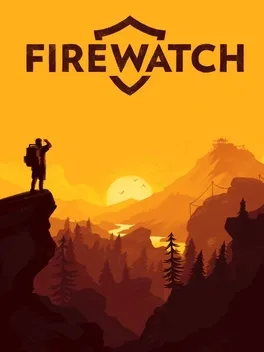
Choosing the words that Henry articulates, then continues to be a prevalent component to Firewatch, but I’d like to focus on discussing the all-encompassing form of gameplay for now. I understand that the majority of gamers are not of the outdoorsy orientation, so I’ll briefly detail the objectives of Henry’s new occupation. A fire watcher’s primary job is to vigilantly monitor their surrounding area for any trace of billowing smoke leading to a flame that could potentially devastate the forest. Upon detecting any arsonist activity, accidental or not, the fire watcher must report their findings to the proper emergency services so it won’t spread into an inferno, calculating its relative distance from their location via the radial alidade device to hone in on its approximate location. Because their lookout tower provides the only reliable visual leverage in efficiently spotting the smoke, the firewatchers are intended to be confined to the lookout tower and fashion it into a modest living quarters, only leaving the premises to relieve themselves at the designated outhouse nearby. However, spending the entirety of the game biding Henry’s time looking at Reader’s Digest and the same pornographic magazine would be a mind-numbing waste of the player’s time. Therefore, Firewatch sort of bends the regulations for our protagonist, extending his duties to a de facto park ranger who hikes around the area looking for any environmental misdeeds that campers may be committing. Even though he only exercises his marginal authority on a couple of unruly, drunken teenage girls after they shoot off some fireworks, Henry spends most of his time hiking around the unadulterated arboreal expanse of the Shoshone wilderness anyway. All of the time Henry spends gallivanting away from his post allows the player to bask in the great outdoors, or at least Firewatch’s polygonal rendering of it. The previous sentence might imply that video game graphics butcher the organic beauty of the outdoors, but the artistic liberties that are facilitated by digital media allow Firewatch to flourish in the visual department. The developers seemingly realized that their work would never match the picturesque postcard backdrops of a wild frontier, which is why they’ve draped a layer of cel shading over their depiction of one. Because the graphics aren’t intended to evoke realism, some of the various visual elements of this type of setting are strikingly more pronounced. Namely, the tangerine glow of the sunset that commonly serves as Firewatch’s time of day. I’d describe it as radiant and transcendental, only if it wasn’t so often obscured by holding up Henry’s map to navigate him through the defined pathways, while using a compass on the other hand as further directional aid as well. Maybe that issue lies more with a lack of confidence in my directional skills, rather than the game actively compromising on one of its strongest elements.
Permission for Henry to learn Shoshone’s layout of hills, valleys, brushes, lakes, canyons, and caves is always granted by his direct superior, Delilah. Unlike Henry, who has taken up firewatching recently, this middle-aged woman has years of experience at a lookout post waiting for an outbreak of flames in the Wyoming wilderness. Similar to Henry, she came across the firewatching position as an outlet of distraction, leaving a life where she had sullied the relationships involving her sister and her long-time lover, Javier. Her knowledge of the Shoshone’s geographical framework makes her a valuable asset in guiding Henry through the tough terrain, radioing her regarding every curiosity he might find on his trajectory. Henry also communicates with Delilah every minute on the field, not only for fastidious checking, but because she is his sole source of human interaction he has in the solitude of both the job conditions and the uninhabited land in which he resides, and vice versa. This mutual thirst for companionship naturally raises the dynamic between Henry and Deliah from a professional relationship to the candidness of genuine friends. Henry’s retorts towards Delilah’s sardonic teasing over their walkies-talkies are where the array of responses comes into play again, and Delilah’s stepping away from the microphone momentarily, depending on whether or not Henry’s responses annoyed or aggravated her, conveys some consequences to consider when selecting a dialogue option. Eventually, after weeks of daily communication, Delilah begins to fancy Henry on a sexual level, flirting with him one night while watching a fire burn over the dark horizon of night. At that point, I realized that I was fully immersed in the role of Henry, for this interaction put a blush on my face and an anxious lump in my throat as if a real woman that I had been communicating with for an extended period started to hint at her horny feelings towards me (in my dreams). The closeness of the characters in states of severe social detachment within the graphic adventure genre reminded me of Simon interacting with Catherine in Soma, except that the circumstances surrounding their interactions aren’t incredibly bleak, so they could potentially blossom into something tangible. The dialogue may be so quippy that it smacks of modern millennial writing unfitting for the game’s set period of the early 1990s, but the banter between them exhibits an adequately believable chemistry.
Instead of taking the obvious route of exploring the conflict of forbidden love between our two central characters, Firewatch kicks the adrenaline of the narrative into high gear when Henry discovers that Delilah’s lewd suggestions were logged on a clipboard by someone. Suddenly, the tranquil atmosphere shifts to paranoid tension, leading Henry to seek this mysterious stalker and give him what for. After several bouts of sleuthing, Henry discovers that the shadowy figure seeing his every step is Ned Goodwin, a former firewatch guard with whom Delilah was once acquainted. Actually, Delilah was better acquainted with Ned’s geeky son Brian, whom he used to bring along to have the harshness of the woods toughen him up. Well, his wish came with the price of his untimely death when Brian is crushed by heavy rocks while rappelling in a cave, an accident that Ned has taken such extreme precautions to veil from his superiors that it’s turned him into an elusive entity existing in the forest like Bigfoot. When Henry finally discovers Ned’s dirty little secret in person, this revelation does not culminate in anything resembling a climax or conclusion for Firewatch’s narrative. Delilah grieves and blames herself for not squealing on Ned before Brian died, and Ned passionately gives Henry an explanation for what happened and to understand his plight. Afterwards, Henry’s firewatching season has come to its 79-day expiration date, and he is escorted away by helicopter without formally confronting Ned or meeting Delilah in person. Like an exceeding majority of Firewatch players, I met the scene in which the game decided to then roll the credits with a befuddled “that’s it?” Both of the game’s two active throughlines seem to peter out before they reach a satisfying conclusion, leaving us with balls as blue as the ocean water in the Maldives. Perhaps I’m not appreciating some sort of genius Chekovian ending approach at play, letting the player ruminate on its ambiguity, which will sprout their own insightful interpretations. Then again, from what I’ve read from the Russian writer, his stories usually don’t elevate the conflict to levels of tension this heightened, and Firewatch raising the stakes just to fizzle away into nothing is just cruel and unusual.
Geez, is Firewatch really an example of how gaming is evolving as a storytelling medium? Plenty of my favorite narratives already come from gaming, and these particular titles didn’t sacrifice the meat of gameplay in order for their stories to flourish. At times, Firewatch reminded me of the strengths that propelled fellow graphic adventure peer Soma as one of the all-time outstanding video game narratives, with solid character interactions and an isolated atmosphere carrying the foundation of the sparse gameplay. However, whereas all of Soma’s right hook story beats KO’d the player with a vicious uppercut of a conclusion, Firewatch failed to stick any sort of landing, seemingly due to the misguided choices of the developers. When your game’s substance relies on its narrative being solid as a military tank, wrapping it up this sloppily is like a flimsy burrito: everything in it falls apart as a result. The ambiance of hiking through a forest isn’t enough to hold my interest, as stunning as it may be. I can’t convey this in writing, but the period I’m using in this Firewatch review is a shrugging gesture.


No comments:
Post a Comment