(Originally published to Glitchwave on 12/4/2025)
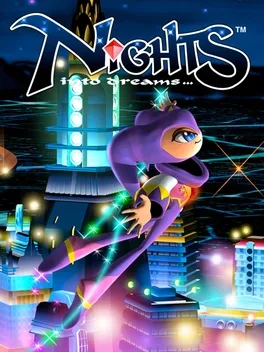
[Image from igdb.com]
NiGHTS into Dreams...
Developer: Sonic Team/Sega
Publisher: Sega
Genre(s): Action
Platforms: Saturn
Release Date: July 5, 1996
Interestingly enough, on a technicality, Nights, the eponymous, gender binary-defying purple jester, is not the game’s protagonist purely from a narrative standpoint. While they’re still technically the primary gameplay vehicle here, the story revolves around two middle-school-aged children named Elliot and Claris, who are not siblings as the surface-level impressions might indicate. Nights is merely a vessel for the boy and girl to enter his native domain of dreams, where the collective of immaterial, subconscious mental fabrications resides. Nights is a trickster with the kid-friendly whimsy and fun of the Cat in the Hat and the pariah status of Beelzebub amongst their fellow “Nightmaren.” However, Night’s rebellion against their kind is portrayed as a sign of courage and righteousness, for they’d rather not be an accomplice to the insidious plan to steal all the dream energy and somehow conquer reality as a result of achieving their goal. The mascot potential of Nights could arguably be undermined by their secondary support status, unlike Sonic, who demands the spotlight like the unapologetic diva he is. Still, the mystique of Nights proves to be far more beguiling because the player’s point of view is from the perspective of two ordinary adolescents existing in humdrum reality. Because we’re never fully stepping into Night's purple poulaines, the impersonal perception preserves the curiosity this character inherently exudes in spades.
Expositing every tidbit of information on the game’s plot premise still won’t demystify the gameplay conditions surrounding each of Night’s levels. Each dream scenario of either children’s campaign is orchestrated around a consistent gameplay loop. In saying that, deciphering said gameplay loop is a process bound to make the player’s brain short-circuit with intense confusion. The game’s first mistake in exhibiting the player’s objective clearly is setting the scene by having them control either Elliot or Claris. Being bushwacked by naughty flying creatures immediately in an automated introductory sequence also establishes a misleading impression that the player is struggling to acclimate themselves to the already-hazy gameplay conditions. It just sets a terrible and inappropriate precedent for the remaining duration of the level. Once either Elliot or Claris enters the mystical gazebo and tags Nights in, they are tasked to retrieve the four multicolored “Ideya Crystals” that were brusquely snatched from the hands of the human children. How does Nights go about reclaiming the four bits of stolen property? Well, that’s when things get tricky. Without any preemptive elucidation, Nights will start flying on a relatively restricted horizontal axis and soar through a series of rings while collecting a smattering of tokens before they travel full circle around again to his outdoor shelter from whence they started. Because the context is clouded in layers of ambiguity thicker than the condensation mist surrounding a large lake, I feel like it’s my due diligence to unveil the intended objective of each level as a favor to all who are about to delve into Nights into Dreams… While every collectible is worth colliding into on a lap around the level, most of them will have to be benched due to the greater precedence of the blue orbs. Twenty may seem like a steep ransom to reach in satisfying the clutches of the “Ideya Captures” claws, but they’ll respawn in the same places once the player makes a 360-degree turn back to the blue gazebo. Once the player returns to the origin point with their twinkling items recovered, they’ll repeat the process another three times, with the level layout shifting with each lap. You’re welcome. I can’t say that I’ve experienced a gameplay formula even remotely close to the one that Nights (literally) revolves around, much less in any previous title produced by Sega. If I had to drum up one comparison for the sake of argument, Night’s levels do foster a similarly swift energy as Sonic’s. Momentum can be quickened at the player’s volition to the point where it can be unmanageable like Sonic at his speediest, which evokes that thrilling rollercoaster aura that I thought the blue blur had trademarked for himself. Shave off the grounded terms and conditions of platforming that Sonic must abide by, and Night’s constant airborne velocity is arguably the next step in evolving this specific brand of Sega gameplay.
However, what does ring Sonic in my ears louder than the SEGA start-up jingle is the snazzy panache that oozes from the game’s presentational pores. They say in the intangible dreamscape that anything is possible, so Sega takes full advantage of the untethered nature of what occurs during REM sleep to unleash their patented bombastic flair to an unprecedented maximalism. Each level, no matter its thematic setting, is brimming with ethereal pizzazz. They’re all relatively organic and firmly recognizable in terms of what topographical environment they’re intended to resemble, but their abstractions lie in the askew properties of the foregrounds. As someone who has been known to dream on a regular basis, I can say from my extensive experience that this unconscious realm often places me in areas that I am particularly familiar with in reality and can’t discern any abnormalities until I awaken and regain my lucidity. What aids the Sonic comparisons is that each level in Nights seems like an unearthly, sublime version of the standard roulette of level themes present on a journey through Mobius. Spring Valley is as divine a grassy, mountainous field as one can get to introduce Nights without calling it “Green Hill Zone,” while “Mystic Forest” amplifies the presence of verdant greenery with some breakable lime mortar blocks from ancient ruins placed as asymmetrically as the tall rocks of Stonehenge. The beachy “Splash Garden” proves Night's superiority underwater compared to the non-swimmer Sonic, while “Frozen Bell” and “Stick Canyon” provide auxiliary vehicles like a snowmobile and gondola to diversify the gameplay in these level themes of polar climates that Sonic is constantly using. It’s a shame they didn’t have enough disc space to incorporate a casino level, for Nights potentially outshining Sonic in his glitziest level theming could constitute as a personal attack. The one level in Nights that sort of verges into more urban, industrialized territory is “Soft Museum,” a standout for possibly referencing an equally surreal novel from William S. Burroughs titled “The Soft Machine.” Sorry Sonic, but the purple jester’s interpretations of your common thematic foregrounds are just too dazzling while they’re operating without the restrictions of reality.
I also apologize that my review is reverting back to a quasi-walkthrough, but it compels me to expound on one prevalent aspect of the levels of Nights that screams Sonic surprisingly before the blue blur ever imagined making it one of his defining idiosyncrasies. In tandem with the score that increases with every sequence of chaining rings in addition to collecting blue orbs and those golden, fin-shaped thingies, the player will be given a letter grade that coincides with the player’s ability to gather the aforementioned whatchamacallits in a timely fashion. The player will likely notice that they aren’t earning acceptable marks by the standards of any education system once they return to the gazebo after rescuing the crystals from their captivity, which is another aspect of the gameplay loop lost in the fog of vagueness. To rack up enough points to pass any kind of class in school, the player must take Nights through the level as many times as the timer will allow after engaging the post-crystal-securing, bonus portion, which will multiply the amount of points received upon reobtaining all of the various collectibles. Essentially, if you’re not playing Nights in a fretful frenzy while a timer ticks down to single digits, you’re not doing it right. Once this obscured gameplay condition came into clarity, it seemed like all I could eke out with my best effort was an adequate “C.” Damn the strict Japanese grading curve! If you think your finishing letter rank is only arbitrary, I must inform you that your GPA must exceed a 2.0 average because the game will deem you unfit to play the “Twin Seeds” final level, where either Elliot or Claris adopts Nights’ aerial mobility to collect orbs over the skyline of their home city and continue to lock its access. As harsh as the conditions to receive an acceptable mark may be, I probably would’ve neglected playing Nights properly if not for the concurrent condition as something to consider.
Amongst all of the unorthodox gameplay elements, would you believe me that each level in Nights climaxes with a distinct boss battle? The Nightmaren appear to be an eclectic army of ghouls led by the enigmatic dark wizard Wizeman, and their design diversity definitely also translates to the unique specifications surrounding how to best them in battle. Because traditional combat in a game like Nights would be rather inappropriate, defeating them requires solving their specific weakness like a puzzle, with the addition of the drill dash maneuver to sprinkle some semblance of offense in these encounters. I’d list their unique weaknesses with the same amount of detail as how to excel in the levels that precede them, but the only way I’d be that charitable is if I were financially compensated. Still, I have to veer into spoiler territory to highlight the egregious aspects that unfortunately beleaguer these bosses. For instance, simply because you’ve discovered how to harm the boss doesn’t mean that you’ll be triumphantly teabagging them in seconds flat. I fully realize that destroying the mice springs is the key to trapping the demonic cat, Clawz, but why then do they tend to compose themselves back to their original states upon drill dashing them like punching a reflex bag? Just because I know that I must direct the rotund Puffy further into the stage doesn’t mean that the awkward, finicky controls will immediately facilitate this desired outcome. Even though each boss (except for the big baddie of Wizeman) isn’t as simplistic as advertised and exposes the slippery nature of the game’s controls, the player will be forced to conquer them as proficiently as any of the levels. Like a final test at the end of a school semester, the time it takes to defeat a boss will factor considerably into the player’s final grade for a level. Failing to vanquish the foe promptly might result in one’s grade dropping by a whole letter. Bollocks. Also, despite how masterfully the player might have run through a level, failing to figure out how to hit a boss's sensitive spot will result in having to repeat the entire level. Mega bollocks. Considering that the game’s levels and bosses exist on entirely different dimensions of gameplay and competency, I’d expressly keep the two separated in the evaluation process like church and state.
Don’t do drugs, kids, or you’ll end up headlining a console doomed to be decimated by Nintendo and the newcomer kid of Sony. While I’m sure the surreal Nights…into Dreams was not initially designed as supplementary material for Sonic, the onus of supporting Sega’s hardware was circumstantially placed on this odd gem, and it couldn’t handle the pressure on its own. Admittedly, one can experience somewhat of the exciting, momentum-based gameplay mostly associated with Sonic here, but in the most perplexing way possible, to the point where any Sonic fan would probably lose their appetite. Night's presentation effectively evokes the marriage of whimsical fantasy and acid-laced psychedelia like Mario, but is bogged down by seemingly emulating the reduced motor skills that come with imbibing the hallucinogen. Nights is just too fucking weird on all fronts not to be condemned to its cult classic status. I appreciate it for its glamor and unparalleled originality, but I’m a weirdo who gravitates towards stuff like this. When a game comes hard to recommend to the average gamer, it shouldn’t be leading the charge into the console wars.


No comments:
Post a Comment