(Originally published to Glitchwave on 12/15/2025)
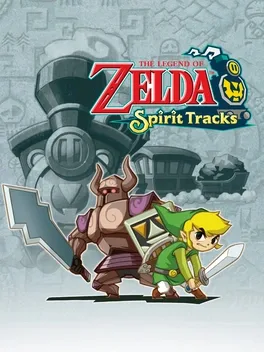
[Image from igdb.com]
The Legend of Zelda: Spirit Tracks
Developer: Nintendo
Publisher: Nintendo
Genre(s): Action-Adventure
Platforms: DS
Release Date: December 7, 2009
One might attribute Spirit Tracks’ favorability to its DS predecessor on the surface-level basis that it has reverted to traditions. Even though this iteration of Link is of the expressive, cel-shaded “Toon” variety, he evidently isn’t confined to the strikingly blue sea that drowned the series’ standard setting as I had presumed he was. No, the bulbous blonde boy (or at least another incarnation of him) now exists in the glorious kingdom of Hyrule without any water damage to speak of, like his fellow green-garbed doppelgangers with sharper physical features. Princess Zelda would probably glare at Link with confusion and concern for his mental well-being if he ever suggested that she had an alternate ego who sailed valiantly with a crew of salty seadogs and spewed sass with the elegant proficiency of a master swordsman. The same sense of befuddlement would probably translate to Link’s sensei Alfonzo, who is a dead ringer for Tetra’s first mate Gonzo. Link and his mentor travel to Hyrule’s capital, where the princess resides, so her majesty can bestow on Link the honor of graduating from his school of engineering, but something wicked will defer the celebration. In the most obvious tell of foreshadowing I’ve seen, when he smiles sinisterly, Spirit Tracks pulls a Chrono Trigger by having Cole, the chancellor in Hyrule’s cabinet, conspire in a murder plot against the princess. The only difference is that Cole succeeds in his nefarious plan with the aid of his equally villainous cohort, Byrne, reducing her to a ghostly, phantom form after one effective Avada Kedavra magic blast. Once the treacherous duo has done away with Her Highness, while also erasing the kingdom’s transportational tracks and seizing control over the Tower of Spirits, the next objective is to use Zelda’s lifeless, vacant body as a vessel for a malevolent demon lord they worship named Malladus. If their intentions aren’t to have Malladus establish a reign of darkness and terror over Hyrule, I’d be shocked. With the dread of their insidious plan potentially coming to fruition hanging over their heads, both Link and Zelda must travel across Hyrule’s vast jurisdiction and retrieve each district's respected sacred Macguffins as par for the Zelda course, which will restore the balance to the kingdom that was just brusquely upset. You read that right, Link AND Zelda will be teaming up on an adventure together for the very first time in over twenty years of the series existing (at the time). She doesn’t exactly provide the same humorous chemistry as Linebeck, but it’s about damn time that the titular series character received a more substantial role in the spotlight of a Zelda title. All it took was pulverizing the poor girl to an immaterial state of being in what is arguably the grimmest Zelda premise to date.
I feel as if I was a bit cagey in detailing certain bits of context behind the premise of Spirit Tracks because they reveal the grander scope of the game’s core gameplay concept that is certainly pervasive enough to warrant its own paragraph. What branch of engineering has our dear Link now reached a graduate level of proficiency in? Railway engineering, as becoming the conductor of a train, is quite a lucrative vocation in an incarnation of Hyrule where this steam-powered mode of transportation serves as the primary method of traversal. You can then imagine how removing the series of tracks would put the kingdom in a state of dysfunction and why it was a fraction of Cole and Byrne’s plans to disrupt order and stability. It goes without saying, but train travel or anything remotely resembling industrialized technology is a first for the series. It even caused contentious outcries from fans who expressed that the concept inappropriately smacked of modernity in a series that should ideally stick to its traditional realm of medieval fantasy. Personally, I fully embrace the idea. My very first fandom, for lack of a better term, between the infancy ages of 2-5 was Thomas the Tank Engine, a British children’s franchise mostly associated with its disturbingly expressive characters juxtaposed with the static movement of their models. Because I spent a great span of my childhood reading the books and watching the TV series, I recognize the quaint charm and whimsy of Thomas the Tank Engine, as the series intends to evoke the warm, wistful sensation of a world through the ubiquity of train travel that was lost in the industrial/digital ages. Wasn’t The Legend of Zelda initially conceptualized as a whimsical retreat back to a less sophisticated period of Miyamoto’s life? Trains certainly weren’t fathomable in the Middle Ages, provided that Zelda is indeed a product of the period’s fantasy tapestry. Still, trains are now antiquated enough to conjure up a yearning for simpler times that no longer exist as society has progressed, a mutual thematic undercurrent between the two aforementioned series. Hence, trains are a wonderful way to give Spirit Tracks some distinctiveness.
Surprisingly, train travel also solves the issue of restrained exploration that was prevalent in Phantom Hourglass. Sailing on the Great Sea in Wind Waker always proved to be a constrained affair, with Link being forced to cooperate with the directional blowing of the seabreeze lest his trajectory come to a sluggish crawl like pumping blood through a clogged artery. Wind was no longer a relevant condition to work around in Phantom Hourglass, but I’d rather pause for a few seconds to change the arrow’s placement than commit to a drawn line that moves Link from the line’s origin point to its destination with no room for deviation. Such rigidity really drove me up a wall throughout the entirety of playing Phantom Hourglass, making even the tiniest of trips grueling on what is possibly the smallest Zelda world map to date. Though the train that Link conducts is restricted even further by design, this does not inherently mean that the traveling process becomes even more suffocating. Link’s train comes with four different acceleration settings: the standard rate of speed and its quickened increase, a brake that slows it to a stop after a few seconds depending on the previous pace, and a reverse function that rolls backwards only at the train’s neutral speed. The player can control the train’s trajectory by tracing the destination route on the tracks like Phantom Hourglass, but the train will still chug along automatically provided the player has its controls set to any sort of acceleration. The player can even change their course by flipping the various track switches found in every fork in the road, even when the train’s trajectory has been laid out by the stylus. If the developers insist on limiting the player’s autonomy in traveling throughout the overworld, at least they’ve now crafted a transportational system around this snag that is sensible and strangely streamlined. As for the combat portion to keep the player entertained during their trips, Link’s train is fashioned with a cannon that shoots an unlimited supply of cannonballs whenever the player pokes the screen with the stylus. Just be careful to sound the whistle by pulling the train horn on the screen whenever an animal is on the tracks instead of an enemy, or else they’ll meet your accidental misdeed by ramming the train like a raging bull. Why is it that farm animals are the most tenacious creatures in the Zelda universe? Also, it’s important to note that the “dark trains” that roam around on the tracks are invulnerable to shelling, so it’s best to evade these mechanical monsters whenever you see them belching pitch-black smoke from their funnels in the distance. They present an opportunity for the player to flex their competency with the train controls, but it is rather annoying having to navigate around them to prevent a fatal collision.
As for the legitimate enemies that can actually be extinguished, their encounters ultimately depend on which district of Hyrule Link is choo-chooing away in at that given moment. Hyrule as depicted in Spirit Tracks really emphasizes the kingdom’s diverse range of ecological themes. Link will start shooting Skulltulas that swing pendulously above the tracks in the shaded groves of the neutral, grassy “Forest Realm.” After that, he’ll travel north, where sentient, hostile snowmen will attempt to pelt his prized train with their own rounded, anatomical pieces that regrow instantly because of the frigid climate that surrounds them. Enemies that resemble flying miniature elephants will dive bomb onto Link in the polar volcanic realm where the Gorons reside, and the aquatic, oceanside realm, where the cumulative sand is bisected to a small desert realm, borrows the floating squids from Phantom Hourglass for the player to beat rupees out of like a piñata. The “Ocean Realm” is also a highlight here because the tense precariousness of holding this hundred-ton train on narrow tracks over deep waters turns into a pure marvelous spectacle when the tracks are submerged underwater, and the train cuts through the drink like a dream. While the eclectic environments are a striking source of Hyrule’s diversity, one could lament that the expanse of this world is subdued by the lack of exploration facilitation caused by the linearity of the train tracks. I feel as if the developers recognized this likely feeling of disillusionment and implemented some unique collectibles to prolong their time in the overworld. Whenever Link docks his train at the assorted destinations alongside the main course, the player should be vigilant about the locations of a “stamp station.” Here, Link can chronicle the various locales around Hyrule for his elderly neighbor in Aboda Village so he can experience the fulfillment of adventure via a second-hand avenue. It’s quite sad, really. While traveling on the tracks, the player should keep the sight of rabbits in their peripheral, for an enthusiast would like to add as many bunnies to his sanctuary in the “Forest Realm” and compensate Link favorably for his troubles. The rabbits also tend to be slippery suckers during the net minigame that engages once Link blasts away the platform situated under it, so be prepared to take note of where their encounters occurred. I was always hesitant to pursue any extracurricular activities available in Phantom Hourglass, but I allotted much of the time between the obligatory sections to wrangle up rabbits and fill that empty journal with each area’s unique artwork for Niko’s pleasure.
Of course, the player can only revel in these interesting subsidiary tasks if they work towards Link’s primary goal of restoring the tracks that lead to each of these locales. I’m sorry if I trigger sensations of shellshock in players who were traumatized by The Temple of the Ocean King, but Spirit Tracks also implements a winding, multi-floored ancient construction that the player chronically revisits after completing a dungeon milestone in the Tower of Spirits. Before you write out a will thinking that a double dosage of a mega dungeon will kill you, know that this colossus is a gentler beast than its older brother. The tall exterior foyer where Link parks his train features a series of entrances that are unlocked with each progression milestone met, meaning that the player can actually continue from the highest floor they’ve unlocked as opposed to digging (or climbing in this case) from the surface and painstakingly retreading one’s steps ad nauseum. In addition, there also isn’t a timer breathing down the player's neck while they jump from floor to floor, mitigating the unnecessary tension and allowing the player to experience meatier puzzles that require more contemplation. Besides fixing everything about The Temple of the Ocean King that made me exclaim “what were they thinking?!” in a rhetorical fashion, Tower of Spirits also provides one of the game’s most distinctive mechanics. Everywhere else in Hyrule, Zelda is but a floating dialogue channeler for our silent protagonist, more in the vein of a windbag buddy like Daxter and less like the notorious series nagger Navi, who attempts to mandate the course of progress at every waking moment. In this lofty monolith, however, she genuinely collaborates with our hero. Spirit Tracks seems to subscribe to the mythical ghost phenomena that claims they can possess living bodies if they so choose, simply absorbing their earthly forms by flying into them. Once Link collects enough of the iridescent tears scattered about the dungeon’s floors, a full set will grant him the power to penetrate the armor of the phantom guards with his sword and allow the incorporeal princess to possess them. Once she’s in a solid, living substrate, Zelda will transmute the physical capabilities of guards for Link’s benefit. Depending on which guard Zelda is commandeering, she can either illuminate darker paths for Link with its flaming sword, teleport via connecting to those annoying phantom eye security drones, and crawl into a ball and roll destructively like a metallic Goron. Above all else, piloting a phantom guard provides a nifty source of camouflage to deflect the guard’s attention to Link’s presence. I don’t know how they aren’t tipped off that there might be a little girl in their midst from the constant wailing for Link to slow down or the high-pitched shrieking whenever a rat crawls around her feet, but I’ll accept their lack of vigilance if it means that Link won’t be forced to scurry away to a pool of imperceptibility at every moment. With Zelda’s distinct set of skills, revisiting the Tower of Spirits is neither a grueling slog nor is it a frantic, frustrating escort quest like Ico with touchpad controls. If anything, it’s the gender-reversed opposite.
Outside of the grandiose Tower of Spirits, Link is expected to carry the weight of heroic duty and Link alone. Fortunately, Spirit Tracks also offers the fabled savior of Hyrule a new slew of untested mechanics in the vein of his items. Before I detail the fresh tricks up the sleeves of Spirit Tracks, I suppose I should mention that the developers deemed either fun or functional enough to return from Phantom Hourglass. Long-distance offense seems to have been the deciding factor, for arrows and the boomerang are the only ones brave enough to show their faces again. You still wanted an item that gives you an excuse to draw on the touchpad, right? If you’re wondering what happened to the hookshot, it’s been replaced with a snaked-faced whip that ultimately functions the same, with the perk of quicker traversal when latching onto the beams. The “Sand Wand” is an especially exciting item, for it allows Link to command large banks of the dry granular material and elevate it at his convenience on the whim of the stylus. If directing sand isn’t stimulating enough, the “Whirlwind” is an item that implements the microphone, creating gusts of wind to forcefully propel enemies and extinguish flames by blowing into the bottom right corner of the DS. The kinetic novelty with this item is certainly nifty, as it feels as if the player’s real breaths are impacting the flow of gameplay. Still, the developers seem to express that picking a direction on a circular plane and exhaling once or twice isn’t challenging enough. Did anyone notice how Phantom Hourglass was an outlier in the Zelda series, as it did not include a musical instrument in any capacity? Well, Spirit Tracks rectifies that glaring omission with what is the most interactive instrument in the series to date, for better or for worse. Link’s musical outlet this time around is a pan flute, a wind instrument that coincides with the kinetic functionality of the DS’s microphone. Notes are symbolized by distinct colors and are scaled from lowest to highest from left to right of the instrument. Like the ocarina, specific bite-sized melodies will affect the environment upon being played and are saved in a journal for the player to use as a visual reference. However, unlike the ocarina, producing any melodious sound is far more enterprising than pressing a series of directional buttons on a controller. The finicky nature of administering air into the pan flute is most prevalent during the duet sequences with a sanctuary’s sage, a process needed to gain access to that area’s dungeon. Link’s practice sessions with the old farts are lengthy enough, but no amount of preparation can prevent the awkward, mismatched snags that come with this kind of kineticism. Thankfully, the sages seem to be understanding and do not angrily ask me if I was rushing or dragging if my pan flute playing wasn’t quite their tempo. Overall, playing the pan flute felt like Plankton running back and forth with a harmonica in “Band Geeks,” or my elementary school days when the staff placed a recorder in front of my face. Yes, notes were played, but with such strenuous conditions involved that I’d hardly call the final product music.
If the player manages to satisfy the sage’s duet requirements, the player should find themselves en route to that area’s dungeon to procure the sacred Macguffin that lies within its deepest layers. Normally, I’d be chomping at the bit to experience the series’ staple labyrinths, but the ones outside of the recurring Tower of Spirits megaplex are rather dull. I really can’t recall much of interest with the first three dungeons, other than that the “Ocean Temple” was unremarkably dry for a dungeon existing underwater. I guess the developers decided not to press their luck in designing a dreaded water level with the unorthodox stylus control scheme. The Fire Temple featured a nifty and complex mine cart segment, while the Sand Temple utilizes its item, the Sand Wand, to the fullest with a myriad of different puzzles and platforming segments. Then again, these types of Sand Wand-oriented instances reappear in droves during the final portion of the Tower of Spirits, which sort of diminishes the distinctiveness of the game’s last elemental palace. I’m thankful that these dungeons are at least competent, but their collective lack of memorable conceits really hurts their impact in the long run.
What salvages these dungeons from totally traveling in one ear and immediately out of the other are the boss battles at their climaxes. Like Phantom Hourglass, the bosses here also serve as examples of the game taking full advantage of the dungeon’s items with the unconventional control scheme at play. Plenty of these pinnacle foes also fully realize the novelty of expanding the scene with the dueling screens of the DS. Gigantic beetle Stagnox will fly upward to the higher portion of the system before trying to ram Link upon reentry, while the green, thorny tentacles of Phytops clog the bottom screen for Link to dodge while he attempts to target the monster’s veiled eyeball that resides in the upper half. Both Cragma and Skeldritch evoke the scope of Eox from Phantom Hourglass, bosses with a skyscraper stature that takes up the space of both screens with its immense verticality, situated in a circular arena where Link is intended to reduce it block by block from below. Above all of these outstanding bosses, the one that impresses me the most is the Demon Train, for it’s a meaty, multiphased foe conquered entirely using the train-conducting skills the player has honed leading up to it. Looking through a less mechanical lens, I’m also quite pleased by the tag team dynamic between Zelda and Link for some of these fights. Both the blonde boy and our dearly departed princess in phantom guard form knock some sense into Byrne at the Tower of Spirits’ peak, and aiming arrows at the backside of Malladus in his demonic physical presence with Zelda while Link distracts his hideousness proves to be a far more engaging collaborative effort than when we trusted NPC Zelda to shoot Ganondorf in Wind Waker. Even Mario and Luigi could learn a thing or two about teamwork from another Nintendo duo that is normally portrayed like Mario and Peach.
Like the kid from that ancient Life cereal commercial, I am in disbelief that I actually like The Legend of Zelda: Spirit Tracks. On the surface, it’s Phantom Hourglass's identical twin still confined to a control scheme that is amusing at best and painfully unintuitive at worst. Still, Spirit Tracks manages to find quality-of-life enhancements when I figured that the foundation was too resolute to work upon. Traversing the overworld is still a bounded excursion, but at least its limitations now make more sense when a railroad system is constructed around it. There still might be a multistoried dungeon with seven floors unlocked per visitation, but at least I no longer anticipate returning with great apprehension because the elements that made the previous mega dungeon insufferable have been omitted and/or reconsidered. Finally, it’s been proven to me that the stylus schematic is not a gimmicky deterrent and that it can foster a functional Zelda experience, but I’d still only recommend it for the series completionists because of its abstract nature. For those who have already seen everything the series has to offer, Spirit Tracks is sounding its deafening train horn to call your attention to it.


No comments:
Post a Comment